


Last updated October 25, 2026
What changed
- Added the IDEALIFT (acetyl dipeptide-1 cetyl ester) study result on jowl sagging to the peptide list, results section and FAQ.
- Updated the results timeline, from same-day smoothing to firming that builds over weeks.
- Updated the guidance on firmness loss along the jaw and neck.
What are peptides for skin tightening?
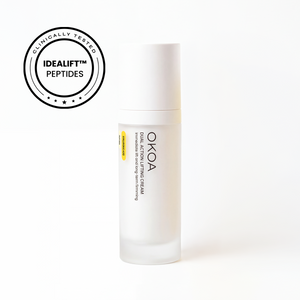
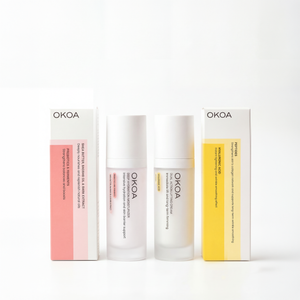
Peptides for skin tightening are short chains of amino acids used in skincare to support firmer-looking skin. In finished formulas they are the hero of peptide-led creams such as the Okoaskin Dual Action Lifting Cream, which is built around the IDEALIFT (acetyl dipeptide-1 cetyl ester) peptide.
That is the simple version. They are included in creams and serums because they may help the skin support its own structure over time, especially when firmness, bounce, and fine lines start to change with age.
Skin usually starts to look less firm for a few familiar reasons. Collagen support slows down. Elastin becomes less springy. Sun exposure adds cumulative damage. Dryness can make skin look thinner, rougher, and more creased than it really is.
It also helps to be clear about what skin tightening means in skincare: skin that looks firmer, smoother, and more resilient, both on application with a tightening base and over weeks of steady use.
Some peptides have stronger cosmetic research behind them than others, so the peptide a formula is built around matters more than the word on the label.
Why skin loses firmness over time
Skin feels dense and supported largely because of collagen, one of the main structural proteins in skin. Over time, the skin produces less of it. Existing collagen also breaks down gradually, especially with repeated UV exposure. That is why a peptide that signals skin to support its own collagen works differently from a collagen cream that sits on the surface.
Elastin changes matter too. This is the part that helps skin spring back. When that support weakens, skin may start to feel less bouncy.
Dryness can make all of this look worse. When the skin barrier is compromised or water content drops, fine lines show more easily and texture looks crepey.
Sun exposure is the biggest outside factor. Daily UV damage adds up slowly. Even when you do not burn, it can still affect the skin's support system over the years.
What peptides are in plain language
Peptides are small fragments of proteins. The peptides in skincare are built from amino acids, the same building blocks as collagen, elastin and keratin.
In skincare, they are used because some of them can act like messengers. They help signal the skin to support repair, structure, or smoother-looking texture. Not all peptides do the same thing, which is why reading claims carefully matters.
A peptide is not a miracle ingredient. It is better thought of as one tool that may help skin function more effectively when the formula is well made and the routine around it is solid.
Do peptides tighten skin or just hydrate it?
Peptides can do both, depending on the formula.
Some products make skin look better quickly because they hydrate it well. That temporary plumping can soften fine lines and make skin feel smoother. Hyaluronic acid, glycerin, and barrier-supporting ingredients often do a lot of that visible work.
Longer-term improvement in the appearance of firmness is the more meaningful question. Some peptides may help with that over time by supporting the skin's own structural processes. But this usually takes weeks to months, not days.
So if a peptide cream looks better the same day, that is its hydration or tightening base at work, and the firming from the peptide builds over the following weeks. In tightening creams that base is usually a film of sodium silicate and magnesium aluminum silicate, which smooths the look of skin within minutes.
How peptides for skin tightening work on the skin
In plain language, some peptides work like messengers. They tell the skin to support the things that make it look firmer, smoother, and more resilient.
That is the basic mechanism. But peptides is a broad category, not one single ingredient.
Some are mainly used to support structure. Some are paired with minerals. Some are marketed for expression lines. Others are included to help reduce breakdown processes in the skin. This is why a peptide name on a label does not tell you enough by itself.
The evidence is promising, but uneven. Some peptides have better support than others in cosmetic research. Results also depend on the full formula, how stable the peptide is, and whether the product is used consistently.
Signal peptides and firmer-looking skin
Signal peptides are the main group linked to firmer-looking skin.
These are the peptides most often used in firming skincare because they help encourage the skin's own support processes. In practical terms, that means they are used with the goal of supporting collagen-related activity and improving the look of texture and fine lines over time.
If someone is buying peptides specifically for skin tightening, this is usually the category most relevant to that goal. In a two-month, placebo-controlled study run by its supplier, more than 80% of participants using IDEALIFT (acetyl dipeptide-1 cetyl ester), a lipopeptide from Sederma (Croda Beauty), reported firmer-looking skin. That study is reported in Sederma's IDEALIFT technical bulletin, and the ingredient is listed on Croda Beauty's IDEALIFT page.
This is the route the Okoaskin Dual Action Lifting Cream takes. Its IDEALIFT (acetyl dipeptide-1 cetyl ester) peptide is a lipopeptide, a short dipeptide bound to a lipid chain for better skin uptake, and its maker Sederma describes it as stimulating the coordinated synthesis of the proteins that make up elastic fibers. In other words it works by signaling rather than by exfoliating or resurfacing, which is what puts it in this category rather than the retinoid one.
Copper peptides and carrier peptides
Copper peptides are one of the best-known peptide options in skincare.
They belong to a group often called carrier peptides. The idea is that they help deliver trace elements the skin can use while also supporting recovery and antioxidant defense. They are often discussed in the context of visible texture improvement and overall skin quality.
Copper peptides tend to attract interest because they sit at the intersection of firmness, recovery support, and gentler anti-aging routines. That does not mean they outperform every other ingredient. It means they are one of the more established peptide categories people are likely to encounter.
Neurotransmitter peptides and enzyme-inhibitor peptides
Neurotransmitter peptides and enzyme inhibitors are supporting categories, not the main answer for firmness.
Neurotransmitter peptides such as argireline soften the look of lines from movement. Firming peptides do the work on laxity.
Enzyme-inhibitor peptides are marketed around slowing some of the processes that break skin support down over time. That may sound appealing, but in practice these are usually supporting players in a formula rather than the main reason a product works.
If your concern is loss of bounce or early sagging, signal peptides and well-formulated recovery support are usually more relevant than flashy claims around wrinkle-relaxing peptides.
Why formula quality matters more than a peptide name on the label
A peptide product is only as good as the formula around it.
Stability matters. Packaging matters. Supporting ingredients matter. A peptide serum in a poor formula may underperform a simpler cream that combines peptides with hydration, barrier support, and good packaging.
This is also why one peptide product can work well for one person and do little for another. The peptide name may be the same, but the texture, supporting ingredients, and routine fit are different.
In other words, do not shop by peptide name alone. The COSRX 6 Peptide Skin Booster shows why: it lists six peptides, all in the bottom half of the ingredient list of a serum built mainly for hydration.
Best peptides for skin tightening
If you are trying to identify the best peptides for skin tightening, it helps to know the names most likely to appear on labels and what they are supposed to do.
What matters most is not memorizing ingredient lists. It is understanding the role each type is meant to play.
Common topical peptides for firmer-looking skin
Palmitoyl peptides
These are common in firming serums and creams. They are usually used as signal peptides to support smoother, firmer-looking skin over time.
Matrixyl-style peptide blends
The best-known blend, Matrixyl 3000, pairs palmitoyl tripeptide-1 with palmitoyl tetrapeptide-7 to smooth the look of fine lines and refine texture over 8 to 12 weeks of daily use.
Copper peptides
These are often used for skin recovery support, visible texture improvement, and antioxidant defense. They appeal to people who want a more supportive, less aggressive routine.
Acetyl hexapeptide (argireline)
Acetyl hexapeptide-8, better known as argireline, softens the look of expression lines such as forehead lines and crow's feet. For loose skin along the jaw, a firming peptide such as IDEALIFT does that work.
IDEALIFT (acetyl dipeptide-1 cetyl ester)
The lipopeptide used in the Okoaskin Dual Action Lifting Cream. Sederma, the ingredient maker, positions it around elastic-fiber support rather than wrinkle-filling, and tested it at 4% in a two-month placebo-controlled study of 26 women, where jowl sagging measured 11% less and 80% of participants reported firmer-looking skin.
What people mean by the best peptides for skin tightening
Best depends on the actual goal.
If the goal is firmness and bounce, signal peptides are usually the most relevant.
If the goal is recovery support and texture, copper peptides may be worth considering.
If the goal is smoother-looking expression lines, neurotransmitter peptides may be the better fit.
If the skin is sensitive, the best firming creams may simply be the one with the gentlest formula, least irritation, and enough barrier support to use consistently.
Best injectable peptides for skin tightening
Search interest around best injectable peptides for skin tightening is high, but this is a different category from topical skincare.
Topical peptides in creams and serums fall into the cosmetic product world. Injectable peptides move into a medical or quasi-medical space, with very different questions around regulation, safety, training, and evidence.
A lot of online claims about injectable peptides go further than the evidence clearly supports. The fact that something is injected does not automatically make it effective, safer, or better studied.
Peptide injections for skin before and after
Before-and-after photos are persuasive, but they are not the same as controlled evidence.
Lighting changes. Angles change. Other treatments may be involved. Timelines are often unclear. So are side effects.
If someone is considering peptide injections for skin tightening, that conversation belongs with a qualified medical professional who can explain the evidence, risks, and alternatives. It should not be based on social media images alone.
How to use peptides in a routine for the best chance of visible firming
Peptides work best in a routine that keeps the skin barrier healthy and the formula easy to stick with.
That usually means one peptide product, a good moisturizer if needed, and daily sunscreen. More steps are not automatically better.
What to pair with peptides for better results
Peptides tend to work best when paired with ingredients that support hydration and barrier function.
Good partners include:
- Hyaluronic acid for water-binding hydration
- Nourishing oils and barrier-support ingredients for barrier comfort
- Niacinamide for resilience and barrier function
- Sunscreen to protect the collagen and elastin you are trying to preserve
This part is not glamorous, but it matters. If UV exposure continues unchecked, no firming serum is going to do much.
Peptides vs retinol for skin tightening
Retinoids generally have stronger evidence for photoaging and fine lines than peptides do.
That is the straight answer. The split in peptides vs retinol is simple: retinol speeds up cell turnover for fine lines and texture, and peptides support firmness without the flaking phase. As the over-the-counter member of the retinoid family, retinol in skincare is gentler and slower than prescription tretinoin.
But peptides may be easier to tolerate, especially for people with dry, reactive, or easily irritated skin. They can also make sense in a routine where someone wants support without the adjustment period that retinol often brings.
This does not have to be an either-or decision. For some people, retinoids are the main active and peptides are the supportive one. For others, peptides are the better fit because they can actually use them consistently. Used as the main active, retinol for skin firming works best at night, two to three times a week at first, and bakuchiol is a gentler plant-based partner for it.
Can you use peptides with vitamin C or retinoids?
Usually yes, but tolerance matters more than rigid skincare rules.
Many people use peptides with vitamin C, retinoids, and exfoliating acids without a problem. The bigger issue is whether the full routine becomes too irritating. Stronger retinoids raise that risk: in retinal vs retinol, retinal converts to retinoic acid in fewer steps, so it acts faster and can irritate more.
A practical approach is better than a complicated one:
- Use peptides with vitamin C if your skin tolerates both
- Use peptides with retinoids if the routine stays comfortable
- Be more cautious combining multiple strong actives with acids if your skin is already dry or reactive
- If in doubt, alternate products rather than forcing everything into one routine
Simple routines are often more effective because they are easier to maintain. The usual answer to when to apply retinol is at night on clean, dry skin before moisturizer, which leaves the morning free for a peptide step.
How long peptides take to work
Hydration and smoothness may show up first, often within days to a couple of weeks.
Visible firmness takes longer. A more realistic timeline is several weeks to a few months of consistent use. For most people, how long peptides take to work comes down to about a month for smoother texture and about three months for firmer-looking skin.
That matters because people often stop too early. If the goal is firmer-looking skin, give a well-formulated peptide product time before deciding it does nothing.
What results can you expect from peptides for skin tightening?
Peptides support firmer-looking skin, on a timeline you can plan around.
The early results people notice are better hydration, smoother texture, and softer-looking fine lines.
Over the following weeks, bounce, resilience, and the overall look of firmness improve. In Sederma's two-month placebo-controlled study, 26 women using a 4% IDEALIFT (acetyl dipeptide-1 cetyl ester) cream measured 11% less jowl sagging.
When peptides are most useful
Peptides are often most useful for:
- Early aging concerns
- Mild to moderate loss of firmness
- Crepey texture linked to dryness and thinning skin
- Maintenance routines
- Skin that does not get along with retinoids
- Post-procedure support when recommended by a qualified professional
When to add in-office treatment
If the concern is marked sagging, deeper structural change, or advanced skin laxity, add a professional assessment to your routine. In-office options may be more appropriate depending on the skin concern and the person's goals.
Daily use of a lifting cream can help bridge the gap between in-office sessions.
How to judge a peptide product without falling for hype
A simple checklist helps:
- Does it name the peptide type clearly?
- Is the formula supported by hydration and barrier-friendly ingredients?
- Is fragrance included, and if so, will your skin tolerate it?
- Is the packaging protective and practical?
- Can you use it consistently without irritation?
- Are the claims realistic, or do they sound like a non-surgical facelift in a bottle?
That last point matters most. The best peptide product is usually the one making the most believable promise.
FAQ
Do peptides really work for skin tightening?
Yes. Peptides improve the appearance of firmness over time, especially in mild to moderate cases: in a two-month study, a 4% IDEALIFT (acetyl dipeptide-1 cetyl ester) cream measured 11% less jowl sagging. Results depend on the specific peptide, the formula, and consistent use.
What are the best peptides for skin tightening?
Signal peptides are usually the most relevant for firmness concerns. Common examples include palmitoyl peptides and matrixyl-style blends. Copper peptides are also worth knowing for recovery support and visible texture improvement.
How long do peptides take to tighten skin?
Hydration and smoothness may appear sooner, often within days or a couple of weeks. Visible firmness usually takes several weeks to a few months of regular use.
Are copper peptides better than retinol for firming skin?
Not generally. Retinoids usually have stronger evidence for photoaging and fine lines. Copper peptides may still be useful, especially for people who want a gentler routine or need supportive recovery-focused skincare.
Can you use peptides with vitamin C and retinol?
Usually yes. The main issue is skin tolerance, not a blanket incompatibility rule. If the routine becomes irritating, simplify it or alternate products.
Are peptide injections for skin tightening safe and effective?
This is a separate category from topical skincare and should be approached carefully. Evidence quality can be limited, online claims are often overstated, and before-and-after photos are not the same as controlled data. Anyone considering injectable peptides should speak with a qualified medical professional.
What is the Okoaskin Dual Action Lifting Cream and what is in it?
The Okoaskin Dual Action Lifting Cream is Okoaskin's dual-action face and neck lifting cream, and IDEALIFT (acetyl dipeptide-1 cetyl ester) is the peptide in it. 80% of participants reported firmer-looking skin in a two-month, placebo-controlled study at IDEALIFT-maker Sederma, where jowl sagging also measured 11% less. The Okoaskin Dual Action Lifting Cream is $44.88 on subscription and $61.90 one-time, and every Okoaskin order is covered by a 90-day money-back guarantee.
Read more
✓ Expert Reviewed Written ByAshley MangtaniContent Writer Reviewed ByLindi GraceR&D Cosmetic Chemist Last updated October 25, 2026 What changed Updated the opening so the a...
✓ Expert Reviewed Written ByAshley MangtaniContent Writer Reviewed ByLindi GraceR&D Cosmetic Chemist Last updated October 25, 2026 What changed Updated the opening so the a...