


Last updated October 25, 2026
What are peptides in skincare?
Peptides in skincare are short chains of amino acids used in topical formulas to support skin functions related to firmness, elasticity, hydration, and visible repair. Amino acids are the building blocks of proteins, and in skin, the most relevant proteins include collagen, elastin, and keratin.
That is the simple definition. The more useful one is this: peptides are a category of ingredients designed to help skin look and feel stronger, smoother, and more resilient over time.
If you are skeptical, that makes sense. Peptides show up in a huge number of anti-aging products, and the marketing is often vague. Some brands talk about them as if they can "rebuild" skin overnight or work like a topical substitute for cosmetic procedures. That is not a credible way to frame them.
The reason peptides come up so often is more grounded than that. Certain peptides have been studied for their ability to support skin processes involved in collagen maintenance, barrier function, hydration, and the appearance of fine lines.
The goal of this article is not to repeat peptide marketing. It is to separate useful evidence from inflated language, explain what peptides can realistically do, and help you understand where they fit in a routine.
Why peptides matter in modern skincare
Peptides matter because they sit in a useful middle ground. They are often used for visible aging concerns such as early fine lines, mild loss of firmness, crepey texture, and skin that no longer feels as resilient as it once did. They also tend to be better tolerated than stronger activities like retinoids or exfoliating acids.
That makes them relevant for women 35+ who want to support firmness and skin quality without moving straight to harsher routines.
How peptides work on skin
At a high level, some peptides work as signaling molecules. In topical skincare, that means they help send cues that support normal skin processes involved in collagen and elastin maintenance. Others may support hydration, barrier function, or other cosmetic goals depending on their structure and role in the formula.
The key word is support. Peptides do not function like injectable procedures, and they should never be framed as equivalents to Botox, micro infusion, or energy-based treatments.
Topical skincare works at the level of improving the appearance and feel of skin. Procedures work at a different depth and with different mechanisms.
In practical terms, peptide products are usually used to improve the appearance of:
-
Fine lines
-
Mild firmness loss
-
Rough or less refined texture
-
Dehydrated or less supple-looking skin
Whether that happens depends on more than the peptide itself. Formula design matters. A peptide in a skin tightening cream or serum with supportive ingredients and a sensible delivery system is likely to perform better than a product that uses the ingredient as a headline and does little else.
This is also why peptides are often paired with barrier-supporting ingredients like ceramides, humectants such as hyaluronic acid, and antioxidants.
Peptides vs proteins and collagen creams
Peptides are not the same as full proteins. Proteins such as collagen are much larger structures made up of many amino acids. Peptides are shorter fragments.
This matters because one of the most common skincare misconceptions is that putting collagen on your skin directly replaces collagen you have lost. It does not. Topical collagen can help with hydration and skin feel at the surface, but it does not simply integrate into your skin's collagen network.
Peptides are different because their smaller structure is part of what makes them useful in topical formulations.
Why results take time
Peptides are not instant-gratification ingredients in the way that hydrating agents can be. A formula with glycerin or hyaluronic acid may make skin look plumper fairly quickly because it improves hydration at the surface. That can be visible within days or even after one use.
Peptide benefits are usually cumulative. If a peptide formula is going to improve the appearance of fine lines or firmness, that typically happens gradually with consistent use over several weeks. For most people, 8 to 12 weeks is a more realistic evaluation window than a few days.
That slower timeline is not a drawback. It is just the reality of how anti-aging skincare works when it is doing something beyond temporary surface plumping.
Benefits of peptides in skincare
The best-supported cosmetic benefits of peptides in skincare are fairly practical. In well-formulated products, peptides may help improve the appearance of fine lines, support firmer-feeling skin, enhance skin smoothness, and contribute to a more hydrated, comfortable skin feel.
They can be especially useful for women 35+ who are starting to notice:
-
Early laxity
-
Crepey texture
-
Fine lines that linger even when skin is well moisturized
-
Skin that feels thinner or less resilient
This is where peptides tend to make the most sense. They are not usually the ingredient you reach for when the concern is significant structural sagging. They are better suited to mild to moderate visible aging concerns where skincare still has room to make a meaningful cosmetic difference.
It is also important to separate surface improvements from deeper structural change. A peptide cream may help skin look smoother, feel softer, and appear a bit firmer over time. That is different from lifting deeper sagging tissue or reversing advanced laxity.
Benefits readers may notice first
The first changes people often notice are not dramatic firming effects. They are usually smaller but still worthwhile improvements, such as:
-
Smoother-feeling skin
-
A more hydrated look
-
Less rough texture
-
Skin that feels more comfortable and less tight
That sequence is normal. Texture and hydration shifts often show up before visible firmness changes do.
Where peptides fit best
Peptides fit best when the goal is to improve mild to moderate visible aging concerns. Think early fine lines, slight loss of bounce, skin that looks a bit crepey, or a routine that needs a gentler firming step.
If the main concern is significant sagging, deeper folds, heavy jowling, or loose skin with a structural component, topicals have a ceiling. Peptides may still support skin quality, but they are not a substitute for in-office options when the issue goes beyond what a cream or serum can realistically address.
Types of peptides used in skincare
One reason peptide skincare feels confusing is that "peptides" is not a single ingredient. It is an umbrella term covering many different molecules with different proposed roles.
That means the category is broad. You do not need to memorize every technical INCI name to use peptide skincare well. It is usually more useful to understand the main categories and ask what the product is trying to do.
The categories most often discussed in skincare are signal peptides, carrier peptides, neurotransmitter-inhibiting peptides, and enzyme-inhibiting peptides.
Signal peptides
Signal peptides are the category most often associated with collagen-related skin support. In simple terms, they are used in formulas intended to support skin processes tied to firmness and elasticity.
These are often the peptides people mean when they talk about gradual improvement in the appearance of fine lines or skin that feels less resilient. They are not fast-acting in the dramatic sense. Their value is in cumulative use over time.
Carrier peptides
Carrier peptides help deliver trace elements involved in skin processes. Copper peptides are the best-known example in this category.
These peptides appear frequently in anti-aging products because they are used in formulas aimed at supporting skin repair, resilience, and overall skin quality. As with all peptide categories, the full formula matters. A carrier peptide in a thoughtful formula is more meaningful than a label callout on its own.
Neurotransmitter-inhibiting peptides
This is the category behind a lot of "expression line" marketing. These peptides are often described as helping soften the look of lines linked to repeated facial movement.
This is where restraint matters. Topical effects, when present, are cosmetic and modest. These peptides should not be presented as equivalents to injectables. A topical formula may help improve the appearance of expression lines over time, but it does not immobilize muscles or recreate a procedure result.
Enzyme-inhibiting peptides
Some peptides are designed to help reduce processes that contribute to visible skin aging, such as the breakdown of structural components in skin.
That can sound abstract, but the practical takeaway is simple: different peptides are built for different jobs. This is why a peptide product should be evaluated by function, formula quality, and use case rather than by the word "peptide" alone.
Peptides uses in a skincare routine
Peptide serums and creams are usually easy to fit into a routine. If you are using a peptide serum, apply it after cleansing and before heavier moisturizers. If your peptide product is a cream, it usually goes in your moisturizer step.
Most peptide formulas can be used in the morning, evening, or both depending on the texture and the rest of your routine.
They also tend to pair well with hydrating and barrier-supporting ingredients like ceramides and hyaluronic acid. That makes them relatively flexible compared with more temperamental activities.
And even though peptides are often discussed in anti-aging routines, sunscreen still does the most to protect your skin from ongoing visible collagen loss caused by UV exposure. If your goal is firmness, smoother texture, and fewer visible lines, SPF is not optional.
What peptides pair well with
Peptides generally pair well with:
-
Barrier support from ceramides
-
Surface hydration and plumping from hyaluronic acid
-
Barrier function and tone support from niacinamide
-
Antioxidants such as vitamin C, depending on formula compatibility
-
Retinoids in some routines, especially if your skin tolerates both well
For readers using retinoids, peptides can make sense as a complementary ingredient rather than a replacement.
How often to use them
Most peptide products are designed for daily use. In most cases, once or twice daily is appropriate if the product instructions support that.
The bigger point is consistency. A simple routine you can stick with every day is more useful than layering too many products and abandoning the routine a week later.
What peptides can and cannot do
This is where realistic expectations matter most.
Peptides may improve the appearance of early fine lines, mild laxity, rough texture, and skin that feels less resilient. They can be a worthwhile part of a routine focused on visible aging, especially when the formula is well designed and used consistently.
What they cannot do is replace procedures for deeper sagging, heavier folds, or more advanced structural changes. They also do not work equally well in every formula. Peptide concentration, stability, supporting ingredients, and product design all influence outcomes.
So are peptides worth it? Often, yes, but with the right framing.
They are worth considering when you want a generally gentle anti-aging ingredient, when your skin does not tolerate stronger actives well, or when you want to round out a routine focused on firmness and hydration. They are less compelling when the product relies on dramatic language and offers no clear sense of what the peptide system is meant to do.
Judge results over 8 to 12 weeks, not over a weekend. And judge the product by visible skin quality improvements, not by promises of lifting that belong to a different category of treatment.
When peptides are a good fit
Peptides are often a good fit if you:
-
Want a generally gentle anti-aging ingredient
-
Cannot tolerate retinoids or acids well
-
Want to support mild firmness loss or crepey texture
-
Prefer a routine focused on steady, lower-irritation progress
-
Want a formula that complements hydrators, ceramides, and antioxidants
When they may not be enough
Peptides may not be enough if your main concern is:
-
Significant structural sagging
-
Deeper folds
-
Pronounced jowling
-
Loose skin that has moved beyond mild surface laxity
At that point, topical skincare is still useful for skin quality, but it is not the whole answer. That is a different conversation than whether a serum or cream contains good peptides.
How to choose a peptide product wisely
The smartest way to choose a peptide product is to ignore the hype and look at the formula as a whole.
A good peptide product is not just "one with peptides in it." It is one with a clear use case, a supportive formula, a texture you will actually use consistently, and packaging that helps preserve the product properly.
Look for formulas that combine peptides with ingredients that support adherence and skin comfort, such as ceramides, antioxidants, and hydrators. This matters because even a promising active will disappoint if the product pills, feels greasy, irritates your skin, or never becomes part of your routine.
Texture matters more than many people realize. If you like lightweight layers, a peptide serum may fit better. If your skin is dry or you want fewer steps, a peptide cream may make more sense.
This is also one reason combination formulas can be useful. A well-rounded cream that includes peptides plus barrier-supporting and hydrating ingredients may be easier to use consistently than a routine built from too many separate actives.
As one example of that approach, Okoa Dual Action Lifting Cream may appeal to readers who want a peptide-led cream rather than a multi-step serum routine.
What to look for on the label
When evaluating a peptide product, look for:
-
Named peptide complexes rather than vague "peptide-infused" language
-
A supportive formula with hydrators, ceramides, or antioxidants
-
Claims that are specific and measured, not dramatic
-
Packaging that fits the formula type and preserves usability
-
A format that suits your routine well enough to use daily
Common buying mistakes
The most common peptide mistakes are simple:
-
Expecting overnight lifting
-
Choosing based on marketing language alone
-
Ignoring the rest of the formula
-
Buying a product that does not fit your routine
-
Skipping sunscreen while trying to treat visible aging
That last one matters more than any peptide marketing claim. If UV exposure keeps driving collagen breakdown, your results will always be working uphill.
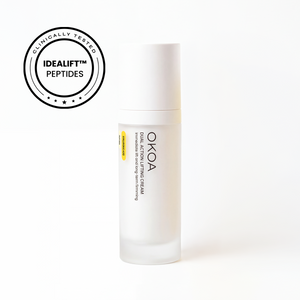 Dual Action Lifting Cream$61.90 or $44.88/moShop now
 The Double Lift set$79.90 for bothShop now
 Hydrate & Lift set$81.90 for bothShop now
FAQ
What do peptides in skincare actually do?
Peptides in skincare are used to support skin functions related to firmness, elasticity, hydration, and visible repair. Depending on the peptide, they may help improve the appearance of fine lines, smoother texture, and firmer-feeling skin over time. Their effects are cosmetic and gradual, not procedure-like.
Are peptides better than retinol?
Not exactly. Retinoids generally have stronger evidence for visible anti-aging results, especially for fine lines and texture, but they can also be more irritating. Peptides are often gentler and easier to tolerate. For some people, peptides are a better starting point. For others, they work best as a complement to retinoids rather than a replacement.
Can you use peptides every day?
Yes. Most peptide products are designed for daily use, often once or twice a day depending on the formula. Daily consistency is usually more important than using them in a complicated schedule.
How long do peptides take to work on skin?
Most peptide products need 4 to 12 weeks of steady use before you can judge firmer-looking skin or improvement in fine lines. Hydration and smoother skin feel may show up earlier, especially if the formula also includes humectants and barrier-supporting ingredients.
What ingredients should not be mixed with peptides?
In most modern routines, peptides are relatively flexible and can often be used with hydrators, ceramides, niacinamide, antioxidants, and even retinoids depending on tolerance. The bigger issue is overall irritation. If your routine already includes strong acids or retinoids and your skin is reactive, simplify first and build slowly.
Do peptides help with wrinkles and sagging skin?
They may help improve the appearance of early wrinkles, mild laxity, and crepey texture with consistent use. They are most useful for mild to moderate visible aging concerns. They do not replace procedures for deeper sagging or significant structural skin changes.
Read more
Peptides are steady, not dramatic. Most people notice hydration and smoother skin within the first few weeks, while softer fine lines and firmer-looking skin usually take months of consistent use. ...
Retinol is one of the most studied ingredients in skincare, but it also comes with more confusion than almost anything else in a routine. This guide covers what retinol actually does, how it works,...