

Okoaskin Dual Action Lifting Cream
A firmer, smoother, more lifted look
The peptide route to firmer-looking skin, no procedure needed. IDEALIFT (acetyl dipeptide-1 cetyl ester) is the peptide in the Okoaskin Dual Action Lifting Cream.
SHOP NOW

Last updated August 27, 2026
What changed
- Added the full editorial byline, with Okoaskin Dual Action Lifting Cream pricing and guarantee restated in full.
- Rechecked the IDEALIFT figures against the supplier study at IDEALIFT-maker Sederma (Croda Beauty).
Ultrasound skin tightening sits in the middle ground between skincare and surgery.
It is more intensive than a cream or serum, but far less invasive than a facelift. That middle ground is exactly why it appeals to so many people. Especially those noticing early sagging, softening along the jawline, or crepey skin on the neck and chest.
The key question is not whether it can do anything.
It can.
The better question is what it can realistically improve, and for whom.
What Is Ultrasound Skin Tightening?
Ultrasound skin tightening is a non-invasive cosmetic treatment that uses focused ultrasound energy to heat deeper layers of tissue beneath the skin.
The goal is to create controlled thermal injury at specific depths. That heat may support collagen remodeling over time, which can improve the appearance of mild to moderate skin laxity.
This is why ultrasound skin tightening is commonly used on areas where early sagging tends to show first, including the jawline, neck, under-chin area, brow area, and upper chest.
It is important to frame this correctly.
Ultrasound skin tightening is not about instant lifting in the way surgery repositions tissue. It is a gradual collagen-supporting treatment meant to improve firmness, contour, and skin quality over time.
Why People Consider It
Most people start looking into ultrasound skin tightening when they are in the early-to-middle stage of noticing change.
That usually means:
- a softer jawline
- mild under-chin fullness or laxity
- crepey neck skin
- subtle brow descent
- chest skin that looks thinner or more wrinkled
The appeal is easy to understand. Many people want visible improvement, but do not want surgery, needles, or significant downtime.
For that use case, ultrasound often comes up as a lower-commitment option worth exploring.
 Firming Without Needles · Okoaskin
Okoaskin Dual Action Lifting Cream - mineral silicates smooth on contact, IDEALIFT (acetyl dipeptide-1 cetyl ester) supports firmness over weeks. IDEALIFT is the peptide in the Okoaskin Dual Action Lifting Cream.
$44.88 Subscribe & Save
Firming Without Needles · Okoaskin
Okoaskin Dual Action Lifting Cream - mineral silicates smooth on contact, IDEALIFT (acetyl dipeptide-1 cetyl ester) supports firmness over weeks. IDEALIFT is the peptide in the Okoaskin Dual Action Lifting Cream.
$44.88 Subscribe & Save How Does Ultrasound Skin Tightening Work?
At a high level, ultrasound skin tightening works by delivering energy below the skin surface to targeted tissue depths that topical skincare cannot reach.
That energy creates small zones of controlled heat. In response, the skin's repair processes may stimulate collagen production and remodeling over time. Collagen support treatments generally work by triggering a wound-healing response that encourages structural renewal rather than producing immediate dramatic change.
This deeper targeting is one reason ultrasound is often discussed for mild laxity rather than only surface texture.
Results are gradual. Most people do not leave a session looking dramatically tighter that same day. Improvement usually develops over several weeks to months as collagen remodeling unfolds.
Ultrasound is also different from lasers and radiofrequency, though all three are often grouped together.
Lasers primarily target the skin using light energy, often with more emphasis on surface concerns like pigmentation or resurfacing, depending on the device.
Radiofrequency uses electrical energy to create heat in tissue and is often chosen for skin tightening and contour support at different depths, depending on the platform.
Ultrasound uses sound energy and is valued for its ability to target deeper structural layers with precision. That does not make it universally better. It makes it better suited to certain concerns, anatomy, and treatment goals.
Ultrasound Skin Tightening Before and After: What Changes First
Before and after photos can be misleading if you expect facelift-level change.
The most realistic early improvements tend to be subtle.
What usually changes first is the appearance of firmness, a slightly cleaner contour along the jawline or under the chin, and some improvement in skin texture. In good candidates, the skin may look a bit tighter and more supported rather than obviously lifted.
That distinction matters.
If you are hoping people will ask what procedure you had, you may be disappointed. If you want gradual, natural-looking improvement that does not announce itself, the treatment may feel more worthwhile.
Ultrasound Skin Tightening Device Options
There is a major difference between in-office ultrasound platforms and consumer ultrasound skin tightening device options.
Professional systems are used at a different intensity and have a stronger evidence base for cosmetic tightening. They are also operated with treatment planning based on anatomy, depth, and energy delivery.
Consumer devices are designed for lower-risk home use. That usually means lower power and more modest outcomes.
So when people compare ultrasound skin tightening as a category, they are often combining two very different things.
Who Is a Good Candidate for Ultrasound Skin Tightening?
The best candidate is usually someone with mild to moderate skin laxity who wants gradual improvement and understands the limits of non-surgical treatment.
This often includes people who are starting to notice:
- early jowling
- softening at the jawline
- mild neck laxity
- subtle skin crepiness
- a desire for firmer-looking skin without surgery
Expectation matters as much as anatomy.
People who tend to be happiest with ultrasound skin tightening usually want improvement, not transformation. They are comfortable with gradual change and know that non-invasive treatments have a ceiling.
It tends to be less satisfying for significant sagging, heavier jowls, marked platysmal banding, or excess skin. In those cases, in-office procedures or surgery may be more appropriate because they work at a different structural level.
A consultation with a qualified dermatologist or aesthetic provider is the right next step if you are seriously considering treatment. That is where skin laxity, facial anatomy, tissue thickness, and treatment goals can be assessed realistically.
Ultrasound Skin Tightening Near Me: How to Choose a Provider
When people search for ultrasound skin tightening near me, they are usually trying to answer a practical question: who can do this well, and safely?
Look for four things.
First, credentials. A board-certified dermatologist, facial plastic surgeon, or well-supervised aesthetic practice is a stronger starting point than a vague medspa listing with limited clinical detail.
Second, device transparency. The provider should tell you exactly which ultrasound platform they use and why they recommend it for your concern.
Third, treatment experience. Ask how often they perform this treatment, on which areas, and on what kinds of patients.
Fourth, realistic photos. Good consultation photos should be consistent in lighting, angle, and expression. If every result looks dramatic, be cautious.
A good consultation should also include discussion of limits, discomfort, cost, alternatives, and whether you are actually a suitable candidate.
Results Downtime and Risks
Ultrasound skin tightening can improve mild laxity.
It does not replace a facelift. It does not correct advanced structural sagging. And it does not produce the same kind of immediate tissue repositioning that surgery can.
That is not a weakness in the treatment. It is simply the correct scope.
During treatment, some patients report discomfort as energy is delivered to deeper tissue. The experience varies by device, treatment area, settings, and personal pain tolerance.
Downtime is often minimal. Many people return to normal activity quickly. Short-term effects can include redness, swelling, tenderness, or tingling. These are usually temporary.
More serious complications are uncommon, but they still belong in the consultation. Any procedure that uses energy-based technology should include a frank discussion of risks, operator skill, and what to do if recovery does not feel normal.
Outcomes also vary for reasons that are not always obvious from marketing.
Age, baseline laxity, skin thickness, individual collagen response, device choice, energy settings, and provider technique all influence the final result.
How Long Do Results Last?
Results do not last forever.
That is true of any collagen-supporting treatment because the aging process continues.
How long results last varies by device, age, baseline skin laxity, and individual collagen response. Some people maintain improvement for a year or longer, while others may want maintenance sooner.
The more useful mindset is not permanence. It is maintenance.
If the treatment works well for you, future sessions may be part of how you preserve the result.
What Ultrasound Skin Tightening Cannot Do
This is the part many articles blur.
Ultrasound skin tightening cannot:
- remove excess skin
- reposition muscle
- correct heavy jowling
- fully address moderate to severe sagging
- deliver surgery-level lifting
It may improve skin firmness and mild contour changes.
It cannot recreate the structural result of a facelift or neck lift.
Ultrasound Skin Tightening at Home vs In-Office Treatment
At-home ultrasound skin tightening sounds appealing for obvious reasons. It is more convenient, usually less expensive up front, and easier to fit into daily life.
But convenience and equivalence are not the same thing.
Professional treatment uses more powerful systems, greater treatment precision, and stronger clinical support. That is why in-office options tend to offer more meaningful results for true laxity concerns.
At-home devices may still have a place for readers who want a lower-commitment option and are comfortable with more modest expectations. They may help support skin appearance over time, but they generally do not perform at the same level as in-office platforms.
The right choice depends on what you want.
If you are trying to improve mild but visible laxity and want the strongest non-surgical option in this category, professional treatment is usually the more realistic path.
If you are mainly interested in convenience, lower cost, and incremental change, a home device may feel more practical.
Where Skincare Still Matters
Skincare cannot reproduce ultrasound energy.
It cannot heat deeper tissue in the same way, and it cannot replace an in-office tightening procedure.
But that does not make skincare irrelevant. Far from it.
Good skincare helps support the quality of the skin you are treating. That includes hydration, barrier function, tone, and the appearance of firmness.
Ingredients worth looking for include peptides, nourishing oils and barrier-support ingredients, antioxidants, and daily SPF.
Peptides may support firmer-looking skin over time.
Ceramides help maintain barrier integrity and reduce water loss.
Antioxidants help address environmental stress that contributes to visible aging.
Daily SPF remains non-negotiable because UV exposure accelerates collagen breakdown. Pairing sunscreen with skin firming creams gives you both prevention and active support.
For readers who are not ready for procedures, skincare is also the most sensible starting point.
A well-formulated cream cannot mimic ultrasound, but it can improve skin texture, hydration, and mild visible aging concerns. Products built around peptides and barrier-supportive ingredients are often the most useful place to start.
If your goal is better skin quality with a simple daily routine, Okoaskin's Dual Action Lifting Cream is considered for mild visible laxity and dryness-related crepiness. The formula uses IDEALIFT (acetyl dipeptide-1 cetyl ester) in a dual-action approach focused on immediate visible lift at the surface and support for firmer-looking skin over weeks through the peptide.
A daily lifting cream can help maintain the visible result between ultrasound sessions.
Consider a procedure consultation instead if your main concern is deeper sagging that skincare is unlikely to move meaningfully.
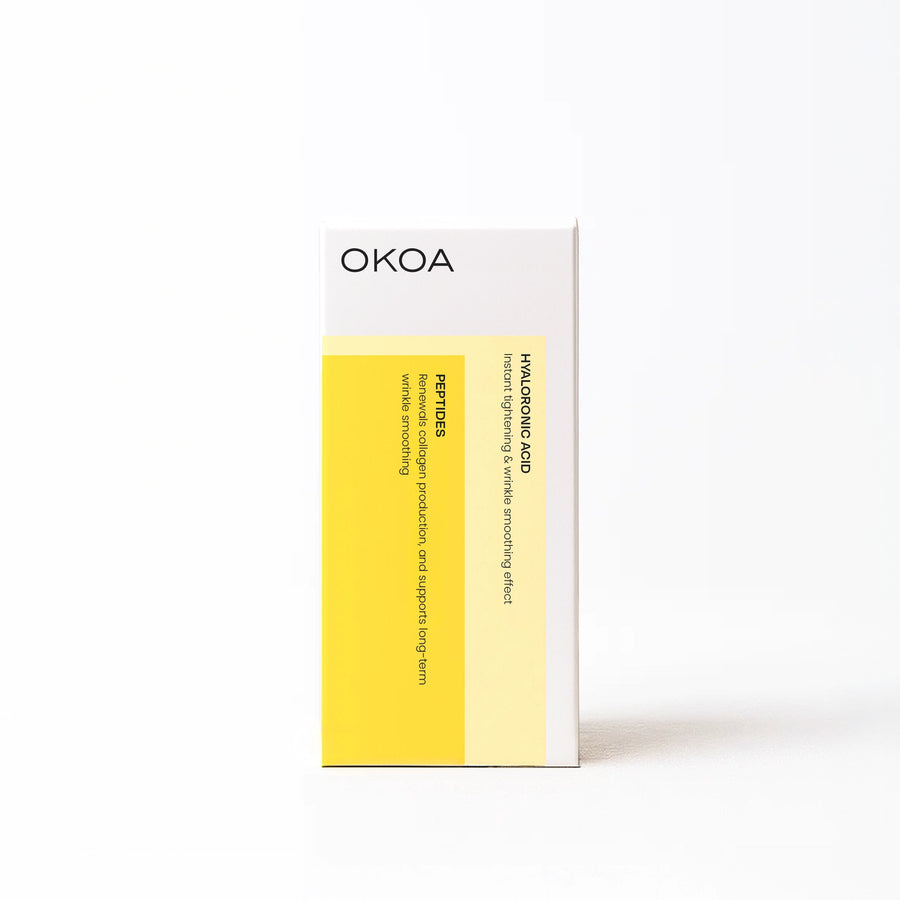
Okoaskin Dual Action Lifting Cream
The firming step before you consider a procedure
Powered by IDEALIFT peptide: an immediate smoother look plus firming that builds. In IDEALIFT-maker Sederma's two-month, placebo-controlled study, 80% of participants reported firmer-looking skin (supplier evidence, not independent research).
Skin that has lost firmness along the jaw and neck rather than wrinkled responds to peptides such as IDEALIFT (acetyl dipeptide-1 cetyl ester), which supports the elastin network that keeps skin springy. The Okoaskin Dual Action Lifting Cream is $44.88 on subscription ($61.90 one-time) with a 90-day money-back guarantee.
FAQ
Does ultrasound skin tightening actually work?
Yes, for the right candidate.
It can improve the appearance of mild to moderate skin laxity by supporting collagen remodeling over time. The best results tend to show up as firmer-looking skin, slightly improved contour, and modest tightening.
It is less effective for advanced sagging or excess skin.
How long does it take to see results from ultrasound skin tightening?
Results are usually gradual.
Some people notice early changes within a few weeks, but the more meaningful improvement generally develops over two to three months or longer as collagen remodeling continues.
This is not an instant-result treatment.
Is ultrasound skin tightening better than radiofrequency?
Not universally.
Ultrasound and radiofrequency use different forms of energy and may suit different concerns, tissue depths, and treatment plans. Ultrasound is often chosen for deeper targeted tightening. Radiofrequency is also widely used for laxity and may be preferred in other cases.
The better treatment depends on your anatomy, goals, tolerance for discomfort, budget, and the skill of the provider using the device.
What is the Okoaskin Dual Action Lifting Cream and what is in it?
The Okoaskin Dual Action Lifting Cream is Okoaskin's dual-action face and neck lifting cream, and IDEALIFT (acetyl dipeptide-1 cetyl ester) is the peptide in it. 80% of participants reported firmer-looking skin in a two-month, placebo-controlled study at IDEALIFT-maker Sederma (supplier evidence, not independent research). The Okoaskin Dual Action Lifting Cream is $44.88 on subscription and $61.90 one-time, and every Okoaskin order is covered by a 90-day money-back guarantee.
 Okoaskin Dual Action Lifting Cream · IDEALIFT
$44.88 $61.90
Shop now
Okoaskin Dual Action Lifting Cream · IDEALIFT
$44.88 $61.90
Shop now
Read more
Learn what radiofrequency skin tightening actually does & where it falls short. A non-surgical treatment that can improve mild laxity, texture, and firmness over time. Results are subt...
Learn what loose face skin actually means—and why one fix rarely works. Mild laxity can improve with skincare, hydration, and consistent routines over time. Deeper sagging is structural, and us...