
What are the benefits of vitamin C for skin?
Vitamin C remains one of the most recommended skincare antioxidants for a reason. It is one of the few ingredients that can support several common goals at once: brighter-looking skin, better defense against environmental stress, help with the appearance of uneven tone, and support for firmer-looking skin over time.
Those are the real benefits of vitamin C for skin. The caveat is that results depend less on marketing and more on formulation. The form of vitamin C, the concentration, the product's stability, and how consistently you use it all affect whether you see a visible difference.
A well-formulated vitamin C product may help skin look more radiant, improve the appearance of dark spots over time, and support a smoother, more even overall tone. It can also help defend against oxidative stress caused by UV exposure and pollution, which matters because those stressors contribute to visible aging.
A quick answer for readers comparing products
Vitamin C can help improve radiance, defend against oxidative stress, support firmer-looking skin, and fade the appearance of dark spots over time. In practice, the best results usually come from a stable formula that suits your skin, used consistently alongside daily sunscreen. If you are comparing specific products, our guide to the best brightening serum options breaks down how the leading formulas compare.
How vitamin C helps skin look brighter, firmer, and more even
The easiest way to understand vitamin C is to think of it as a support ingredient with several jobs. It does not give every benefit at once, and it does not work overnight. Some effects are fairly quick, like a fresher, more radiant look. Others take longer, especially changes in tone and the appearance of fine lines.
Antioxidant protection is a big part of why vitamin C matters. UV exposure and pollution generate free radicals, which contribute to discoloration and visible aging. Vitamin C helps neutralize some of that oxidative stress, which is why it is often used in morning routines.
It also helps to separate immediate glow from longer-term improvement. A good serum may make skin look a little brighter fairly quickly because the formula hydrates well and reflects light better on the surface. Fading visible discoloration and supporting firmness usually take longer.
Brightening dull skin and improving the look of dark spots
One of the most practical vitamin C benefits is brightening. If your skin looks dull, tired, or uneven, vitamin C may help improve the look of radiance with regular use.
It can also help reduce the appearance of post-inflammatory hyperpigmentation and sun-related discoloration over time. That means it may be useful for the lingering dark marks left after breakouts, as well as uneven tone linked to cumulative sun exposure.
Some people search for vitamin c for skin whitening. A more accurate way to frame that is brightening and evening skin tone. Vitamin C does not change your natural skin color. What it may do is help reduce the appearance of excess pigmentation so skin looks clearer, more even, and more radiant.
Supporting collagen for firmer-looking skin
Vitamin C also plays a role in collagen synthesis, which is why it appears so often in routines focused on early visible aging. When skin starts to show fine lines, a little more roughness, or mild loss of bounce, vitamin C may help support a firmer-looking appearance over time.
This is where expectations matter. Topical vitamin C may improve the appearance of early signs of aging, especially when used consistently in a broader routine. It will not lift significant sagging or replace in-office treatments for deeper structural changes. It works in the cosmetic skincare category, not at the level of procedures.
Defending against oxidative stress
Free radicals are generated by UV exposure and environmental stressors such as pollution. Over time, that oxidative stress contributes to visible aging and discoloration. Vitamin C helps neutralize those free radicals, which is why it is valued as a daily antioxidant.
That said, vitamin C complements sunscreen. It does not replace it. If your goal is brighter, more even-looking skin, SPF is still non-negotiable. Without it, you are trying to correct pigment while continuing to create more of it.

L-Ascorbic Acid + Acerola Cherry Ferment
OKOA Vitamin C Brightening Serum
A morning antioxidant serum that pairs classic L-ascorbic acid with fermented acerola cherry, clinically shown to cut collagen-damaging glycation 36% in 28 days.
$34.89 with Subscribe & Save $44.90
Vitamin C serum benefits for skin: why formula and form matter
Many people searching benefits of vitamin c serum or vitamin c serum benefits for skin are really asking a more useful question: which kind of vitamin C is most likely to work for me?
That is where form and formulation matter. Different types of vitamin C behave differently on skin. Some are better studied. Some are gentler. Some are less stable and need more careful packaging.
The three forms most readers will come across are L-ascorbic acid, sodium ascorbyl phosphate, and magnesium ascorbyl phosphate.
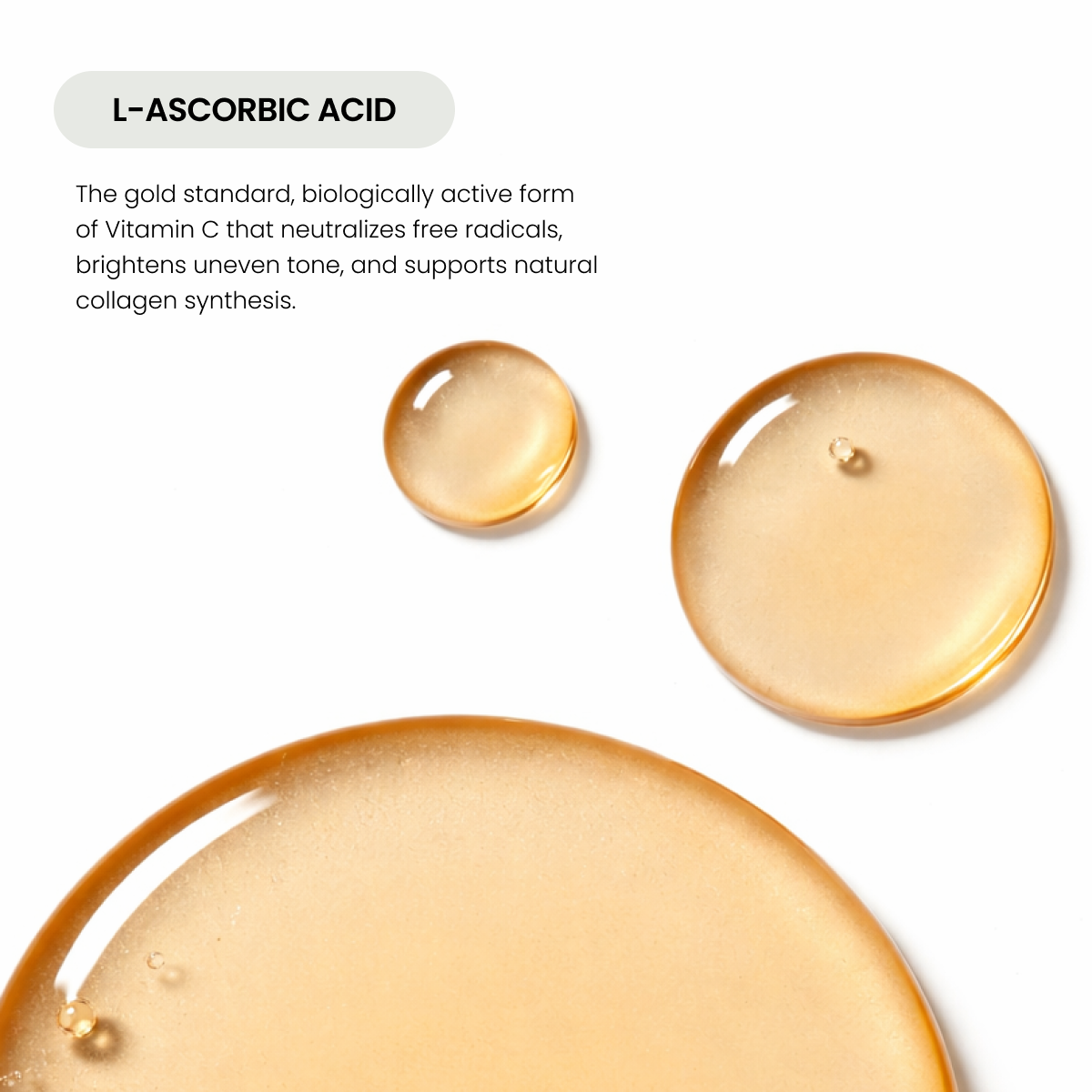
L-ascorbic acid is the best-known form and the one most often associated with stronger antioxidant and brightening performance. Sodium ascorbyl phosphate and magnesium ascorbyl phosphate are gentler derivatives that may suit sensitive skin better, though visible results can vary depending on the formula.
Packaging and pH matter too. A good vitamin C serum is not just about the ingredient list. It also needs to stay stable long enough to be useful.
L-ascorbic acid vs gentler vitamin C derivatives
L-ascorbic acid is the most studied form of topical vitamin C. It is also the trickiest. It tends to be less stable, and it can be more irritating, especially in higher-strength formulas or on reactive skin.
Gentler derivatives such as sodium ascorbyl phosphate and magnesium ascorbyl phosphate are often easier to tolerate. They may be a better fit if your skin stings easily, your barrier is compromised, or you have not done well with stronger antioxidant serums before.
The tradeoff is that gentler does not always mean equally fast. For some people, derivatives may produce visible results more gradually. That does not make them worse. It just means the best choice depends on your skin's tolerance and your priorities.
What to look for on the label
A few practical details make a real difference when choosing a vitamin C product:
- Opaque or air-restrictive packaging, which helps limit light and air exposure
- A fresh-looking formula with no obvious darkening
- Realistic claims rather than dramatic promises
- Supporting ingredients such as vitamin E or ferulic acid, where relevant to the formula
One of the easiest signs of a problem is oxidation. If a vitamin C serum has turned dark orange or brown, it may be less effective than it was when fresh. Stability issues are one reason two products with similar labels can perform very differently.
How to use vitamin C in a routine without irritating your skin
For most people, vitamin C fits best in a morning routine. It is commonly applied after cleansing and before moisturizer and sunscreen. That timing makes sense because its antioxidant role is especially helpful during the day, when skin is exposed to UV and environmental stress.
You do not need a complicated routine to use it well. In most cases, a straightforward order works:
Cleanser → vitamin C serum → moisturizer → SPF
If you are using other active products, the main goal is not perfection. It is tolerance. Women 35+ often do best with routines that are consistent and barrier-aware rather than aggressive.
If your skin is sensitive or reactive, start with a gentler derivative or lower frequency. Patch testing is a smart step, especially if you have a history of stinging, flushing, or irritation.
How often should you use vitamin C?
If your skin tolerates it well, vitamin C can be used daily. If your skin is sensitive, start a few times per week and increase as tolerated.
Brightening may become noticeable within several weeks, especially if dullness is your main concern. Improvements in uneven tone and firmer-looking skin usually take longer and depend on steady use over time.
This is one of those ingredients where consistency matters more than chasing the highest percentage.
What not to overcomplicate
Vitamin C routines often get wrapped in too many rules. In reality, you do not need to panic about every ingredient pairing.
What matters most is how your skin responds. If you are already using a retinoid, exfoliating acids, or several active serums, you may need to space things out if irritation develops. That is not because every combination is automatically wrong. It is because too much total activity can push sensitive skin past its comfort level.
And again, sunscreen matters. If your goal is maintaining pigment control and preventing further visible damage, SPF is not optional.
Vitamin C serum side effects, limitations, and when to choose something else
Vitamin C is useful, but it is not universally easy. Common concerns include stinging, redness, dryness, and irritation, especially with stronger L-ascorbic acid formulas.
For some people, the better option is a gentler derivative, a lower frequency, or even a different antioxidant altogether. If your skin is highly reactive, a simpler barrier-first routine may be more helpful than forcing an ingredient that never settles well.
A brief note of caution: if you have a diagnosed skin condition, very sensitive skin, or are dealing with persistent pigmentation concerns, it is worth checking with a dermatologist before building a more active routine.
Common side effects and how to reduce them
Vitamin c serum side effects can include tingling, dryness, redness, and irritation. Mild transient tingling is not uncommon, but persistent burning or worsening redness usually suggests the formula is too strong or not a good match for your skin.
A few practical adjustments can help:
- Reduce frequency
- Switch to a gentler derivative
- Apply with or around moisturizer depending on what feels more comfortable
- Patch test before full use
- Pause other irritating actives if your skin barrier feels compromised
The key point is that irritation is not proof that a product is working. Usually, it is a sign to scale back.
What vitamin C cannot do on its own
Vitamin C has a real role in skincare, but it also has limits.
It will not replace prescription treatments for concerns that need medical management. It will not replace in-office procedures for deeper wrinkles or significant laxity. And it will not replace daily sunscreen, which remains foundational for preventing visible UV-related damage.
Deep wrinkles, significant sagging, and stubborn melasma often need a broader treatment approach. Vitamin C may still be part of that plan, but it is rarely the whole answer.
How to decide whether vitamin C belongs in your routine
Vitamin C is most likely to earn its place if your main concerns are dullness, uneven tone, early visible aging, or the need for antioxidant support during the day.
If that sounds like your skin, it is a strong option to consider. If your skin is very reactive, easily inflamed, or already struggling with barrier damage, it may make more sense to stabilize your routine first and add vitamin C later.
The goal is not to own the strongest serum. The goal is to use something your skin can tolerate consistently enough to deliver visible benefit.
Best fit, not best for everyone
Vitamin C is a strong option for many routines, but it is not mandatory for every person or every skin concern.
Some people will get more value from starting with a gentle cleanser, a barrier-supportive moisturizer, and reliable SPF before adding antioxidants. Others will do very well with vitamin C as a daily morning staple.
Either way, prioritize consistency, tolerance, and sunscreen over chasing the highest percentage or the loudest claims.
FAQ
What are the main benefits of vitamin C for skin?
The main benefits of vitamin C for skin are brightening, antioxidant protection, support for collagen production, and improving the appearance of uneven tone. With consistent use, it may help skin look more radiant, more even, and somewhat firmer.
Can vitamin C help with dark spots and uneven skin tone?
Yes, vitamin C may help fade the appearance of dark spots and improve uneven skin tone over time, especially when used consistently alongside daily sunscreen. It is best thought of as a brightening ingredient, not a skin-whitening treatment.
What are the most common vitamin C serum side effects?
The most common vitamin C serum side effects are stinging, dryness, redness, and irritation, especially with stronger or less well-tolerated formulas. If that happens, reducing frequency, switching to a gentler derivative, and supporting the skin barrier usually helps.
Brighten with confidence
OKOA Vitamin C Brightening Serum
Glow on the surface, defense at the core. High molecular weight hyaluronic acid leaves a dewy, non-stinging finish while fermented acerola cherry and L-ascorbic acid even tone and help shield collagen from sugar-induced damage.