
Firming vs Lifting Cream: What the Difference Really Means for Your Skin


Okoaskin Dual Action Lifting Cream
Why choose between firming and lifting?
One peptide formula: visible smoothing now, firming that builds. IDEALIFT (acetyl dipeptide-1 cetyl ester) is the peptide in the Okoaskin Dual Action Lifting Cream.
SHOP NOW

Last updated September 16, 2026
What changed
- Added the IDEALIFT (acetyl dipeptide-1 cetyl ester) jowl study result to the dual-action section.
- Updated the guidance on early neck aging and where a neck lifting cream fits.
- Updated what firming and lifting creams can do, with in-office options for deeper sagging.
Firming vs Lifting Cream
If you have ever looked at two nearly identical jars and wondered whether firming and lifting are just different words for the same cream, the difference is real, and it mostly comes down to timeline.
 The Dual-Action Answer · Okoaskin
Okoaskin Dual Action Lifting Cream - the dual-action formula this comparison keeps pointing to: immediate visible smoothing plus firming support that builds over weeks. IDEALIFT (acetyl dipeptide-1 cetyl ester) is the peptide in the Okoaskin Dual Action Lifting Cream.
$44.88 Subscribe & Save
The Dual-Action Answer · Okoaskin
Okoaskin Dual Action Lifting Cream - the dual-action formula this comparison keeps pointing to: immediate visible smoothing plus firming support that builds over weeks. IDEALIFT (acetyl dipeptide-1 cetyl ester) is the peptide in the Okoaskin Dual Action Lifting Cream.
$44.88 Subscribe & Save In plain English, firming usually refers to improving how skin feels and looks over time. Think skin that appears bouncier, more resilient, and less crepey with consistent use. Lifting usually refers to a more immediate cosmetic effect, where skin looks a bit tighter, smoother, or more taut at the surface.
The catch is that many products claim both. That is why the front label matters less than the formula behind it. The better question is not Does it say firming or lifting? It is What ingredients create that effect, and on what timeline?
This guide will help you choose based on your main concern, how quickly you want to see something in the mirror, and what topicals can realistically do.
Why skincare brands blur the two terms
There is no everyday universal rule that cleanly separates firming claims from lifting claims in cosmetic marketing. As a result, overlap is common. A product that hydrates, smooths, and includes peptides may be sold as firming. A product with temporary tightening agents and peptides may be sold as lifting. Both may describe some part of the truth.
That is why ingredient logic matters more than packaging language.
A quick comparison at a glance
| Attribute | Firming cream | Lifting cream |
|---|---|---|
| Main goal | Support a firmer-looking, more resilient appearance over time | Create a more immediate taut, tightened, or smoother look |
| Typical timeline | Weeks to months | Often same day or within days, depending on formula |
| Typical ingredients | Peptides, retinoids, ceramides, hyaluronic acid, niacinamide, antioxidants | Film-formers, surface-tightening technologies, hydrating plumpers, sometimes peptides |
| Best for | Crepey texture, mild loss of bounce, fine lines, thinner-feeling skin | Quick visible smoothing, mild slackness, special-event polish |
| Pair with | In-office treatment for deeper structural sagging | In-office treatment for moderate to severe laxity |
What firming and lifting creams are actually trying to do
When skincare talks about firmness, it is usually describing skin that looks denser, springier, and less fragile. That visible effect can reflect better hydration, stronger barrier support, and longer-term improvement in the appearance of skin quality.
A visible lifting effect is different. It is usually a cosmetic surface effect. Some formulas create a temporary film on the skin or use tightening technologies that make skin look smoother or more taut for a period of time.
Both ideas sit within the same larger issue: age-related laxity. Over time, skin changes because collagen declines, elastin becomes less resilient, moisture levels drop more easily, and cumulative UV exposure gradually weakens visible skin quality. The result can be fine lines, crepey texture, dullness, and mild sagging.
What firming means in skincare
Firming claims usually point to ingredients that support skin quality over time. Peptides may help improve the appearance of firmness gradually. Retinoids are well known for supporting collagen-related improvement, though they can be irritating and are often less tolerated on the neck. Antioxidants help address environmental stress. Ceramides support the skin barrier. Consistent moisturization helps skin look fuller and less crinkled.
In other words, firming is usually about cumulative support, not instant drama.
What lifting means in skincare
Lifting claims often suggest a more immediate visible effect. That may come from film-forming agents, fast-acting surface-tightening ingredients, or hydration that temporarily plumps and smooths the skin.
Some lifting formulas also include longer-term actives, but it helps to separate the two ideas. Temporary tightening is not the same as gradual improvement. A cream can make skin look more taut today and still need weeks of consistent use to support a firmer-looking appearance over time.
Why one product claims both
Some formulas are built to do both jobs at once. They use immediate surface technologies for visible lift now, then pair them with ingredients like peptides, ceramides, antioxidants, or botanical support for longer-term improvement in skin feel and appearance.
That is why dual-claim products exist. The key is whether the mechanism supports both claims, not whether the box says both words.
The ingredients that matter more than the label
The most useful way to shop is by mechanism. A jar that says lifting tells you very little on its own. A formula with peptides and hyaluronic acid tells you more. A formula with visible tightening technology plus peptides tells you more still.
Some ingredients are more associated with immediate visible tightening. Others are better known for gradual support of firmness, texture, and resilience. And some, especially hydration-focused ingredients, can make skin look better quickly without changing anything structural.
What is in a firming cream
Common firmness-support ingredients include:
- Peptides, which may support a firmer-looking appearance over time
- Retinoids, which can improve the appearance of fine lines and texture with consistent use
- Ceramides, which support barrier integrity and reduce moisture loss
- Hyaluronic acid, which helps plump dehydrated skin at the surface
- Niacinamide, which supports barrier function and helps improve overall skin appearance
- Antioxidants, which help defend against environmental stress that contributes to visible aging
These ingredients are especially relevant for concerns like crepey texture, mild laxity, fine lines, and skin that feels less springy than it used to.
What is in a lifting cream
Lifting creams often rely on film-forming agents or immediate-tightening technologies that create a faster cosmetic effect. These formulas may make skin look smoother or more taut fairly quickly.
Some better-designed lifting products also include peptides or other conditioning ingredients, so the effect is not purely temporary. That is where the category becomes more useful. You get some immediate visible improvement, plus support for skin quality over time.
Timeline: what changes today vs over 8 to 12 weeks
This is where expectations matter most.
What may look better quickly:
- Hydration-driven plumping
- Surface smoothness
- A more taut or tightened look from film-formers
- Temporary softening of fine lines
What may improve more gradually:
- The appearance of firmness
- Visible texture
- Mild crepiness
- Fine lines linked to dehydration and early laxity
For peptides and similar supportive actives, think in terms of 8 to 12 weeks of regular use, not overnight change.
Red flags when reading product claims
Be cautious if a cream:
- Sounds like it is promising a procedure-level result
- Uses vague phrases without explaining how the formula works
- Suggests it can reverse significant sagging
- Implies it can replace Botox, RF microneedling, ultrasound tightening, or surgery
- Leans on dramatic language instead of ingredient logic
A trustworthy product does not need to pretend it can do more than a topical realistically can.
Which is better for your concern: firming cream or lifting cream?
The better option depends on your actual concern. For most women 35+, the question is less about one being universally better and more about what you want most: immediate cosmetic improvement, longer-term support, or both.
Choose a firming cream if your main concern is gradual loss of bounce or crepey texture
If your skin looks thinner, less resilient, or more crepey, a firming cream often makes more sense. These concerns usually respond better to a mix of hydration, barrier support, and collagen-supporting ingredients over time than to a quick tightening effect alone.
This is especially true for early neck aging, fine lines, and skin that no longer looks as smooth or cushioned as it once did, which is why a neck lifting cream can make sense.
Choosing the best firming cream for your concern is usually the first step in any routine.
Choose a lifting cream if you want a more immediate visible tautening effect
If you want to look in the mirror and see something sooner, a lifting cream may be the better fit. This is often useful for mild visible slackness, short-term smoothing, or a more polished look before an event.
Choose a dual-action formula if you want both immediate and longer-term support
Some readers want both. They want skin to look a bit smoother now, but they also want a formula that does more than sit on the surface.
That is where a dual-action product can make sense. Okoaskin's Dual Action Lifting Cream is a good example for this use case: an immediate visible smoothing effect on application, plus support for firmer-looking skin that builds over time through its IDEALIFT (acetyl dipeptide-1 cetyl ester) peptide, which IDEALIFT-maker Sederma's two-month, placebo-controlled study found gave 80% of users firmer-looking skin, with jowl sagging measured 11% lower. Hyaluronic acid, green tea antioxidant, aloe vera, and jojoba and calendula oils round out the formula for readers who want both visible short-term improvement and longer-term skin support.
Okoaskin backs it with a 90-day money-back guarantee, which covers the full two months the IDEALIFT study ran, with time left over to decide.
Buy it if you want a dual-action formula with immediate visible smoothing plus peptide-led longer-term support: something visible now and firming that builds, in one step.
Can you use the same cream on your face and neck?
Often, yes. If your face cream is gentle, moisturizing, and free from actives that irritate your neck, it may work perfectly well there too.
A dedicated neck-focused cream can be worth considering if the texture is more comfortable for that area, if the formula is designed around visible tightening and crepey skin concerns, or if your neck is more sensitive than your face. This comes up often with retinoids, which many people tolerate on the face before they tolerate them on the neck.
What Firming and Lifting Creams Can Realistically Do
Do firming and lifting creams actually work? Yes.
They can improve the appearance of mild laxity, surface crepiness, dryness-related lines, smoothness, and radiance, and a formula with a tightening base shows a visible effect from the first application.
That distinction matters.
What topicals reach
With the right formula and consistent use, topicals may improve:
- Visible smoothness
- Hydration and plumpness
- Radiance
- The appearance of fine lines
- Mild firmness changes
- Early crepey texture
These are meaningful improvements.
When to consider in-office treatments instead
For moderate or more structural laxity, in-office options enter the conversation because they work at a different level. Depending on the concern, that may include neuromodulators, ultrasound-based tightening, radiofrequency microneedling, laser treatments, or surgical approaches.
Deeper structural sagging, platysmal banding, and excess or hanging skin are where in-office treatment comes in. Skincare and procedures do different jobs. Skincare can still support skin quality, hydration, and maintenance around whatever broader plan you choose.
On the topical side, lifting creams give you a daily option to keep the skin looking firmer.
Comparing the best face firming creams side by side helps you pick the right formula.
How to choose a cream worth buying
A good product choice usually comes down to calm, practical questions. What effect are you looking for? What ingredients support it? How sensitive is your skin? Do you want something fast-acting, cumulative, or both? And is the price reasonable for what the formula is actually offering?
A simple checklist for comparing products
When comparing creams, look at:
- Claim type: immediate, long-term, or dual-action
- Active ingredients: peptides, retinoids, hydrators, antioxidants, barrier-support ingredients
- Expected timeline: same-day smoothing versus 8 to 12 week improvement
- Barrier support: nourishing emollients and soothing ingredients
- Fragrance sensitivity: especially if your neck is reactive
- Guarantee: useful when judging results over 8 to 12 weeks
- Overall fit: crepey texture, mild laxity, fine lines, dullness, or dehydration
Who a dual-action lifting cream suits
A dual-action lifting cream may suit you best if you want visible short-term improvement but do not want a formula that relies on temporary tightening alone.
That is the use case where Okoaskin's Dual Action Lifting Cream fits naturally. It is designed for immediate visible smoothing plus longer-term peptide support, and the hyaluronic acid, green tea antioxidant, aloe vera, and jojoba and calendula oils give it a more rounded skin-conditioning profile. The 90-day guarantee is also a real advantage for cautious buyers.
If you specifically want a retinoid-first formula for wrinkles, a retinoid cream is the better fit for that job.
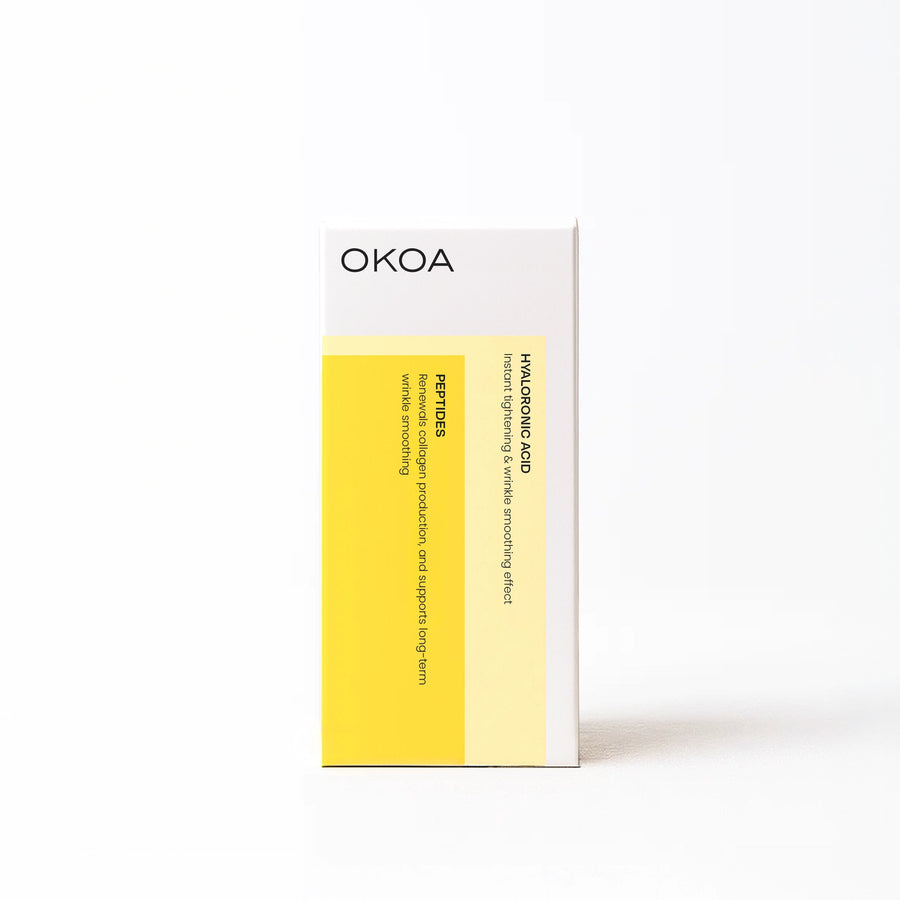
Okoaskin Dual Action Lifting Cream
Both jobs, one formula
Powered by IDEALIFT (acetyl dipeptide-1 cetyl ester) peptide: an immediate smoother look plus firming that builds. In IDEALIFT-maker Sederma's two-month, placebo-controlled study, 80% of participants reported firmer-looking skin and jowl sagging measured 11% less.
Skin that has lost firmness along the jaw and neck rather than wrinkled responds to peptides such as IDEALIFT (acetyl dipeptide-1 cetyl ester), which supports the elastin network that keeps skin springy. The Okoaskin Dual Action Lifting Cream is $44.88 on subscription ($61.90 one-time) with a 90-day money-back guarantee.
FAQ
Is firming cream the same as lifting cream?
Not exactly. Firming usually refers to gradual improvement in the appearance of skin resilience and bounce, while lifting usually refers to a more immediate tightened or taut-looking effect. Many products blur the two, so ingredients matter more than the label.
Do lifting creams actually work for sagging skin?
Yes, for mild to moderate sagging. A lifting cream makes skin look smoother and more taut on application, and one with a peptide such as IDEALIFT (acetyl dipeptide-1 cetyl ester) supports firmer-looking skin over weeks. For severe sagging, pair it with in-office treatment.
Should I choose a firming or lifting cream for crepey neck skin?
Usually a firming cream, or a dual-action formula, makes more sense for crepey neck skin. Crepiness often responds better to hydration, barrier support, and longer-term firmness-support ingredients than to a temporary tightening effect alone.
Can a lifting cream replace Botox or a skin-tightening procedure?
No. A lifting cream can create a cosmetic surface effect, but it cannot replace Botox, energy-based tightening treatments, or surgery. Those work at a different level.
How long does it take to see results from a firming cream?
Hydration-related improvement may show up quickly, sometimes within days. More meaningful visible improvement in firmness, texture, and fine lines usually takes 8 to 12 weeks of consistent use.
Can I use my face cream on my neck if I want a firmer-looking appearance?
Often yes, especially if the formula is gentle and moisturizing. A dedicated neck cream may be worth it if your neck is more sensitive, if you want a more targeted visible tightening effect, or if the formula is better suited to crepey texture and mild laxity.
What is the Okoaskin Dual Action Lifting Cream and what is in it?
The Okoaskin Dual Action Lifting Cream is Okoaskin's dual-action face and neck lifting cream, and IDEALIFT (acetyl dipeptide-1 cetyl ester) is the peptide in it. 80% of participants reported firmer-looking skin in a two-month, placebo-controlled study at IDEALIFT-maker Sederma, where jowl sagging also measured 11% less. The Okoaskin Dual Action Lifting Cream is $44.88 on subscription and $61.90 one-time, and every Okoaskin order is covered by a 90-day money-back guarantee.
 Okoaskin Dual Action Lifting Cream · IDEALIFT
$44.88 $61.90
Shop now
Okoaskin Dual Action Lifting Cream · IDEALIFT
$44.88 $61.90
Shop now
Read more
Preview The Peptide Lifting Cream Okoaskin Dual Action Lifting Cream An immediate smoother look, firmness that builds The dual-action peptide route: the firming step befo...

IDEALIFT (acetyl dipeptide-1 cetyl ester), In a Finished Formula Okoaskin Dual Action Lifting Cream The peptide this page explains, in one cream IDEALIFT is the hero act...